
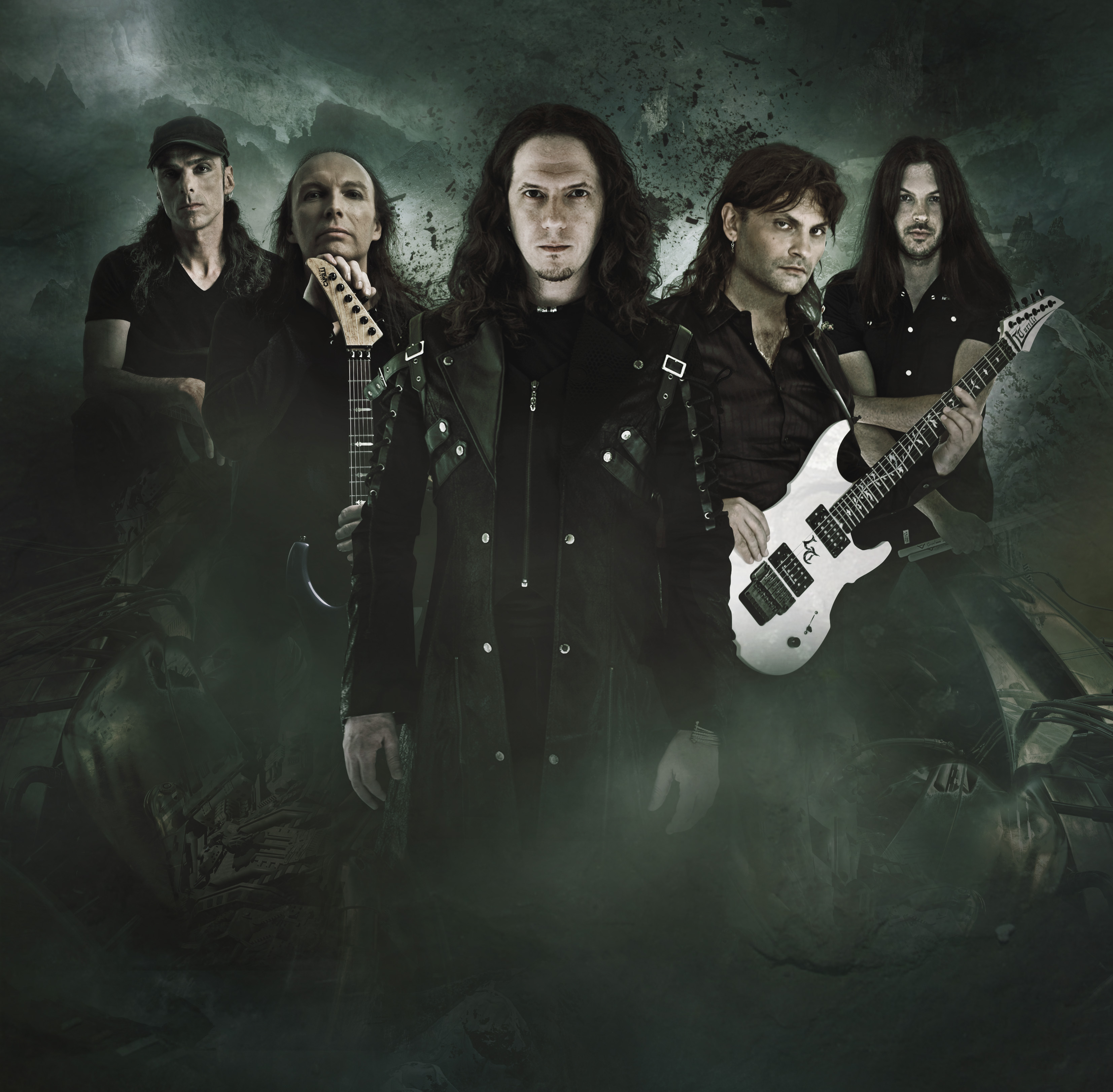
It’s not an exaggeration to say that Luca Turilli has changed the face of Power Metal as a genre.
When Rhapsody’s debut Legendary Tales (Limb Music) burst onto the scene in 1997 amidst a shower of rainbows and unicorns it hit a moribund, tradition-bound genre like a glass of ice water to the face. Combining huge Power Metal choruses with the panoramic sweep of film soundtracks, a completely irony-free fantasy concept (complete with map) and the kind of genuine, unmodified joy that isn’t often heard in popular music of any kind, the band became genre-leaders overnight, and guitarist/composer Luca Turilli cemented his importance through a string of solo albums before branching off on his own. With his new Luca Turilli’s Rhapsody project – now onto their second album through Nuclear Blast – he’s putting out some of the most daring, distinctive and emotionally resonant music to be released under the Power Metal label in years.
Luca Turilli’s music is passionate, powerful and filled with a sort of joyous open-mindedness, and even through the muddy and unreliable medium of an international Skype call it’s clear as Luca enthuses about music, spirituality and his work with the late Sir Christopher Lee that he possesses all of these qualities himself.

One thing that seems really striking about the last two albums is how far they go beyond the traditional Heavy Metal influences, taking in not only the expected Classical and Soundtrack influences, but also Italian Pop. Did this feel like a risky move after leaving a band with such a clearly defined sound?
“Yes, absolutely – it’s always risky to do something like that, but when you are a composer you can’t just compose the same thing fifteen years after you started. I have such energy flowing in me every day – I put myself in front of the computer or the piano, or with the guitar to compose and I channel this into my music. For Prometheus – Symphonia Ignis Divinus I wrote twenty songs in the first two-three months, then I had to select ten or eleven titles, which at 70 minutes is already the longest Rhapsody album.
“We have so many different styles – I really consider myself more of a composer than a guitar player or a piano player – I always have this variety between albums. Especially now, since the split with Rhapsody – for the first ten albums everything, musically, lyrically was related with this saga I created, this kind of fantasy saga. After finishing that, I think the possibility of covering different themes, different topics – even though they’re all connected by this main theme of spiritual evolution – it means I can say different things, offer different styles and different colours, on the one album. I was really feeling the need for this, and I feel very proud of this new album.
“It was very risky, of course – there were some people saying “What is this? What about Enchanted Lands? (Limb)” – this is a problem of illegal downloading, where people will just pick up the new one and say “what, you changed style?”. I’ve been doing this already! I also have a completely new audience, and it’s amazing for me to have this potential crossover – I can reach people who like soundtrack music from the cinema, people who like more opera – I think Rhapsody has always had this potential in some way, but with this new band I’m really free to reach anyone.”

Is this freedom something you’ve gained since leaving original Rhapsody/Rhapsody Of Fire? Do you feel more able to express yourself honestly with this new set-up?
“Many people ask me “Will you go on with your solo career now you have Luca Turilli’s Rhapsody?” and I always say no. Why should I? If you look the solo albums I was composing when I was with Rhapsody or Rhapsody Of Fire, you will notice all of these sounds I could not use in Rhapsody because of this fantastic story connecting ten albums – I don’t know how many bands in the history of music have honestly done that, it was a real emotional journey for us, incredible – but in some ways it was missing something. I am more of a composer than a player, for me it’s important to compose, and I like a lot of soundtrack styles – at that time it was the beginning of 2000, there were a lot of films like Lord Of The Rings, but there was also The Matrix Trilogy with this kind of soundtrack, very electronic.
“So I really felt the need to compose the soundtrack albums to include what I could not use in Rhapsody – not that I could not because Alex (Staropoli) wouldn’t let me – just because of what we were doing. So now, of course, there is no need for me to make any more solo albums because of what I can do with this new Rhapsody. I’m looking at lots of different opportunities to make music for movies, for video games, but Rhapsody will always be my top priority simply for one thing – I have complete freedom. With Luca Turilli’s Rhapsody band I have found the perfect equilibrium, total freedom and an amazing situation.”

The symphonic and soundtrack elements have been present since the first Rhapsody album, of course, but with the last two albums you’ve become considerably more successful at realising them.
“Now, when I write orchestral parts, it is so much easier than it was with early Rhapsody. Now with computers, I have one of the most powerful systems for classical composition in Europe in my home. I really want to be able to compete with the great composers of soundtracks in the US and Hollywood, so I really need technological support. In the morning I have breakfast, then I have all of the sounds in the planet in front of me – my own creativity is the only limit!
“When we started Rhapsody in the 90’s with the aim of doing something new the support of the technology was not that great – we were typing note by note on a keyboard sequencer! The Korg 01/W Pro – I remember because it was our partner in the composition of the albums, and in some way of course that’s why it was taking so long. Now it’s easier, and I can create a great orchestration in a shorter time. That’s also part of the freedom I talked about – just technically I can make music now that would have been impossible or taken too long in the beginning.”
Prometheus: Symphonia Ignis Divinus is available now via Nuclear Blast
RICHIE HR

